
Trump said that the strait will be "open very soon" if ongoing negotiations with Tehran continue successfully.

Indian benchmark indices Sensex and Nifty traded lower amid volatile trends, influenced by escalating geopolitical uncertainties in West Asia and fresh outflows from Foreign Institutional Investors (FIIs).

The Quad grouping has expanded cooperation in critical minerals and energy, while unveiling new measures to boost maritime surveillance and port infrastructure across the Indo-Pacific. This move comes against the backdrop of China's growing military posturing in the region, with ministers reiterating strong opposition to destabilising actions and expressing serious concerns over militarisation of disputed features.

'They talked bad about our leaders. They said India was a dead economy. They were not sensitive to the Indian psyche.'
Despite current headwinds, India remains the world's fastest-growing major economy and should not allow near-term challenges to obscure its long-term growth potential, said Jane Fraser, Citi Chair and Chief Executive Officer.

Prime Minister Narendra Modi and Indonesian President Prabowo Subianto have significantly advanced the India-Indonesia Comprehensive Strategic Partnership, securing crucial agreements on defence, critical minerals, and maritime security, including BrahMos missile supply and Sabang port development.

External Affairs Minister S Jaishankar addresses the Indian Ocean Conference, expressing deep concern over the West Asia conflict and its economic repercussions on energy, trade, and food security. India calls for a swift return to peace and opposes targeting civilians and infrastructure.

Indian stock market benchmark indices, Sensex and Nifty, experienced declines in early trade due to escalating tensions between the US and Iran, which led to a surge in crude oil prices and weak global equity trends.

'1991 was an exceptional period in Indian history.' 'A big 400-volt shock was administered to the system, which was required. Today, we are in a much, much better position.'

India has expressed firm opposition to attacks on merchant shipping amidst the ongoing Iran conflict, revealing that several Indian nationals have died or are missing due to these incidents. The nation also called for restraint, de-escalation, and prioritising civilian safety in the region.

India has raised concerns with Iran over the safety of merchant shipping after two vessels were fired upon in the Strait of Hormuz, prompting them to turn back.

Morgan Stanley analysts, led by Ridham Desai, predict that the next phase of the Indian market rally will be primarily driven by the April-June quarter (Q1FY27) corporate earnings season and the performance of the monsoon.

Modi's comments on underlining the importance of ensuring the safety of seafarers came against the backdrop of growing anger in India over the killing of the three Indian crew members in a US military attack on a merchant ship off the coast of Oman last week.

Indian benchmark equity indices, Sensex and Nifty, extended their rally for a fifth consecutive session, driven by optimism surrounding a potential US-Iran peace deal and a significant drop in crude oil prices. Despite hawkish remarks from the US Fed, investors remain hopeful that easing energy prices could temper inflationary pressures.

Commerce and Industry Minister Piyush Goyal announced that India expects to operationalise nine free trade agreements (FTAs) within the next 10 months, with plans for an additional three to four significant pacts over the coming year, reinforcing India's ambition to become a global manufacturing and investment hub.

Chief Economic Advisor V Anantha Nageswaran stated that India's economy is projected to return to a 7 per cent-plus growth trajectory by 2027-28 (FY28), or sooner if external conditions improve, despite near-term challenges from the West Asia crisis.

Global oil prices fell on Thursday to their lowest levels since before the outbreak of the Iran conflict, offering a significant economic tailwind for India, the world's third-largest crude importer, by easing inflation risks, reducing the import bill and improving the government's fiscal position.

Indian benchmark indices Sensex and Nifty surged significantly in early trade, tracking a global rally fueled by US President Donald Trump's declaration of an end to the war with Iran and a subsequent drop in crude oil prices.
Fathali further stated that Tehran has instructed its embassy in India to facilitate the Indian government, ensuring smooth operations amid the ongoing regional conflict.

US Secretary of State Marco Rubio will visit India from May 23-26 to enhance cooperation in trade, defence, and energy, attending meetings with senior Indian officials and participating in a Quad group meeting in New Delhi.

Morocco's impressive rise in global football is uniquely funded by its vast phosphate reserves, with the state-owned OCP Group investing heavily in national team development. This strategic investment, driven by a royal directive, supports training academies and infrastructure, contributing to the nation's recent successes like reaching the 2022 World Cup semi-finals and hosting the 2025 Africa Cup of Nations. The country's abundant phosphate resources provide a stable economic base for these ambitious sporting endeavours.

Reserve Bank Governor Sanjay Malhotra announced that India's foreign exchange reserves stand at a healthy $682.3 billion as of May 29, 2026, providing approximately 11 months of import cover and strong protection against external shocks.
Indian equities on Dalal Street saw volatility as global market trends and oil price hike impacted investor sentiment. Track Sensex, Nifty50 movement and key market drivers for Apr 23, 2026.

US President Donald Trump met with Chinese President Xi Jinping in Beijing to discuss trade, technology, Taiwan, and the Iran war. Xi Jinping said that 2026 will be a 'historic, landmark year' for China-US relations.
Indian equity benchmark indices Sensex and Nifty experienced a significant tumble in early trade, with the Sensex tanking nearly 700 points, driven by uncertainty surrounding US-Iran negotiations, a fresh spike in crude oil prices, and persistent foreign fund outflows.

Indian benchmark indices Sensex and Nifty closed flat, paring early gains due to renewed hostilities between the US and Iran, which unsettled investor sentiment and led to profit booking in metal, oil & gas, and telecom shares.
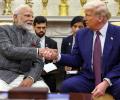
Amidst escalating tensions with Iran, the US has granted India a temporary 30-day waiver to continue purchasing Russian oil, aiming to stabilise global energy markets and encourage future US oil imports by India.

Indian benchmark stock indices, Sensex and Nifty, extended their winning streak for a third consecutive day, driven by positive global market trends and a significant softening of crude oil prices following a peace deal between the US and Iran.

Poland's Secretary of State, Wladyslaw T Bartoszewski, has credited Prime Minister Narendra Modi with preventing Russian President Vladimir Putin from using tactical nuclear weapons in Ukraine in late 2022, highlighting Modi's significant influence on the Russian leader.

The escalating crisis in West Asia and its impact on the global energy supply chain are expected to dominate deliberations at a two-day meeting of BRICS foreign ministers to be hosted by India.
Indian equity benchmark indices Sensex and Nifty declined in early trade, driven by persistent concerns over the unresolved US-Iran situation and continued outflows from foreign institutional investors.

'India should understand that we are not going to make the same mistakes with India that we made with China 20 years ago.'

Indian benchmark indices Sensex and Nifty climbed in early trade, driven by a significant drop in crude oil prices following reports of a potential 60-day ceasefire extension between the US and Iran, coupled with positive global market trends and buying in IT stocks.

Iran has reimposed restrictions on the Strait of Hormuz, with its forces opening fire on a passing tanker and forcing at least two Indian vessels to reverse course, escalating tensions in the region and raising concerns over energy supplies.

US Secretary of State Marco Rubio says relations between India and the US have not lost momentum and are set to strengthen, with hopes for a trade deal soon.

A new report suggests China's maritime vulnerability lies in the Strait of Hormuz, not Malacca, creating strategic competition in the Indian Ocean.

The United States has announced it will not renew sanctions exemptions for the purchase of Russian and Iranian oil, ending a 30-day waiver that allowed some countries, including India, to continue importing Russian oil despite sanctions related to the Ukraine war.

Indian benchmark equity indices Sensex and Nifty surged in early trade, driven by a sharp correction in crude oil prices below USD 100 per barrel and a rally in global markets, fuelled by improving sentiment surrounding US-Iran negotiations.

If we really want to curb the further depreciation of the rupee and make the rupee appreciate, we want to come out of the mindset that the exchange rate is merely a number, bring policy corrections to help reduce the outflow of foreign exchange by imposing suitable tariffs to discourage imports and bring self reliance, discipline FPIs, and correcting rules governing royalty outflows, suggests Dr Ashwani Mahajan, National Co-Convenor, Swadeshi Jagaran Manch.

Prime Minister Narendra Modi urged US President Donald Trump to prioritise the safety of Indian seafarers in the Strait of Hormuz during the implementation of Washington's proposed Iran peace deal, as both leaders focused on repairing strained bilateral relations at the G7 summit.
